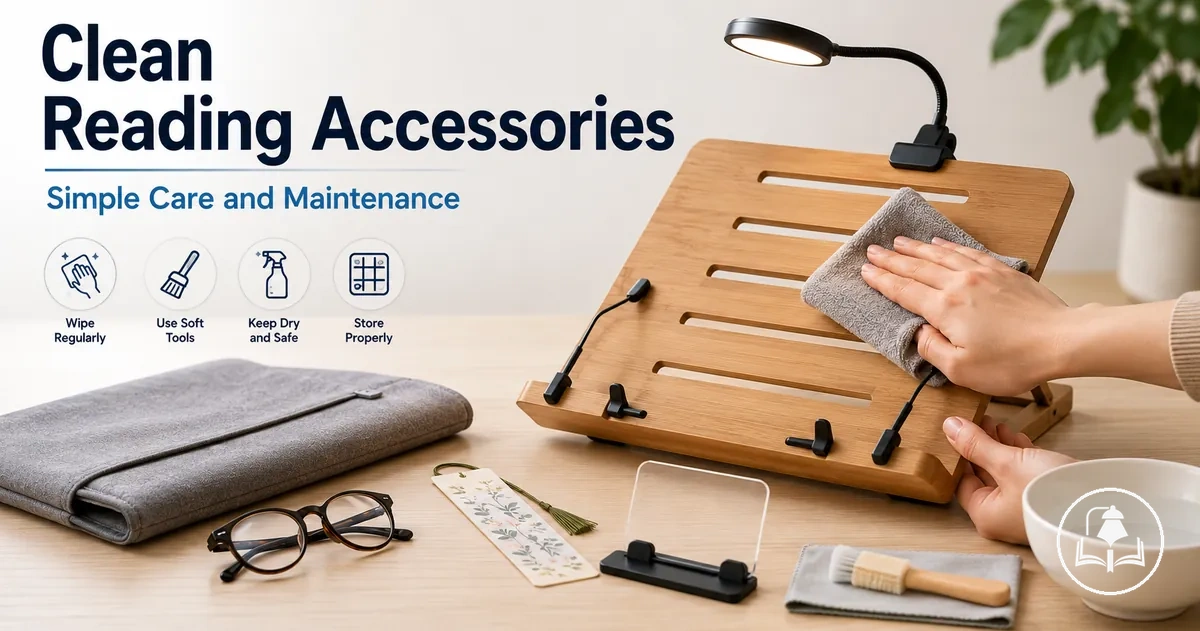
Reading Accessory Cleaning and Maintenance
Reading accessory cleaning and maintenance refers to material-aware care practices used to keep reading accessories usable, clean, and stable over time. It focuses on how different materials and surfaces respond to dust, moisture, and handling. The safe method depends on accessory type, surface sensitivity, and condition. It also considers how drying and residue control affect overall usability.
In practice, common cleaning risks come from excess moisture, residue buildup, abrasion from rough wiping, and unintended exposure of electronic parts. These issues can affect surfaces such as coated finishes, fabric layers, and small mechanical joints if handling is not controlled. Dust accumulation and improper drying may also reduce usability across different reading accessories. Managing these risks requires focusing on material and surface characteristics before choosing any cleaning approach.
Many users handle mixed reading accessories such as supports, lights, sleeves, and page tools that combine different materials in one setup. Each item may require a different balance of moisture control, dust removal, and handling care. This variation makes it important to prepare for surface-specific methods rather than a single routine approach.
Accessory Materials That Determine the Cleaning Method
Material determines how reading accessories respond to cleaning pressure, moisture exposure, and cleaner choice. Hard surfaces can tolerate more controlled wiping, while softer or coated surfaces require lighter handling to reduce surface sensitivity. This distinction shapes how cleaning and maintenance should be approached across different designs, including hard plastic, metal, fabric, foam, leather-like coverings, lenses, screens, clips, and hinges.
Many reading accessories combine multiple materials in one structure, and each part may react differently during cleaning. For example, a single item may include a rigid frame, a soft padded section, and a coated surface used for viewing or support. Joints or clips can also introduce additional sensitivity to moisture and residue buildup. This makes it important to evaluate each material section separately rather than applying a single cleaning approach.
When the material is uncertain, the safest approach is to reduce cleaning intensity and avoid strong moisture exposure until surface behavior is clearer. A small test spot on a hidden area can help indicate sensitivity before broader cleaning. Manufacturer guidance, when available, can also clarify acceptable cleaning limits for mixed surfaces and coated parts.
Accessory Materials That Determine the Cleaning Method shows how material differences shape moisture tolerance and cleaner tolerance. The table organizes common material groups by cleaning sensitivity and risk level.
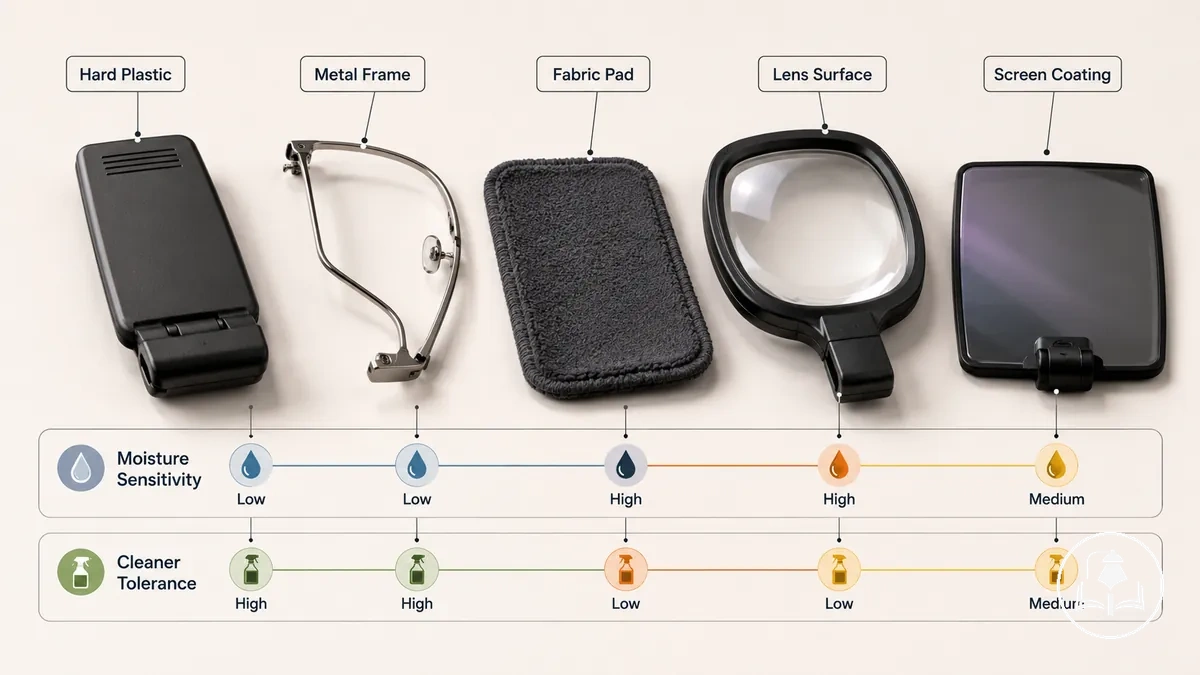
| Accessory material or part | Cleaning sensitivity | Safer condition | Risk to avoid |
|---|---|---|---|
| Hard plastic | Low to moderate | Light damp wiping with controlled moisture | Excess water penetration or abrasive scrubbing |
| Metal | Low to moderate | Dry or slightly damp wiping with residue control | Corrosion from trapped moisture |
| Fabric | High | Dry dust removal or minimal moisture spot care | Over-saturation and slow drying deformation |
| Foam | High | Gentle surface dusting with minimal pressure | Moisture retention and structural breakdown |
| Leather-like coverings | Moderate to high | Soft dry wipe with careful surface control | Surface cracking or moisture absorption |
| Lens | High | Microfiber dry cleaning with light pressure | Scratch risk from rough materials |
| Screen | High | Dry or lightly damp microfiber wipe | Coating damage from harsh cleaners |
| Clip | Low to moderate | Dry wiping with residue removal focus | Jamming from buildup or corrosion |
| Hinge | Moderate | Targeted cleaning with controlled moisture | Stiff movement from trapped residue |
Safe Cleaning Tools and Cleaners for Reading Accessories
Safe cleaning tools and cleaners for reading accessories are generally gentle, low-moisture, and matched to the surface they are used on. This reduces risks such as residue, scratching, staining, and moisture damage across different reading accessories. The selection must stay separate between physical tools and cleaning solutions to maintain surface control.
Using abrasive materials or excessive liquid increases the chance of scratching, staining, and trapped residue in seams or coated areas. Delicate surfaces like lenses and screens are especially sensitive to pressure, while fabric and padded sections can absorb moisture and retain it. This is why tool selection should stay focused on controlled application rather than intensity. The list below separates tools and cleaners based on their surface behavior and risk level.
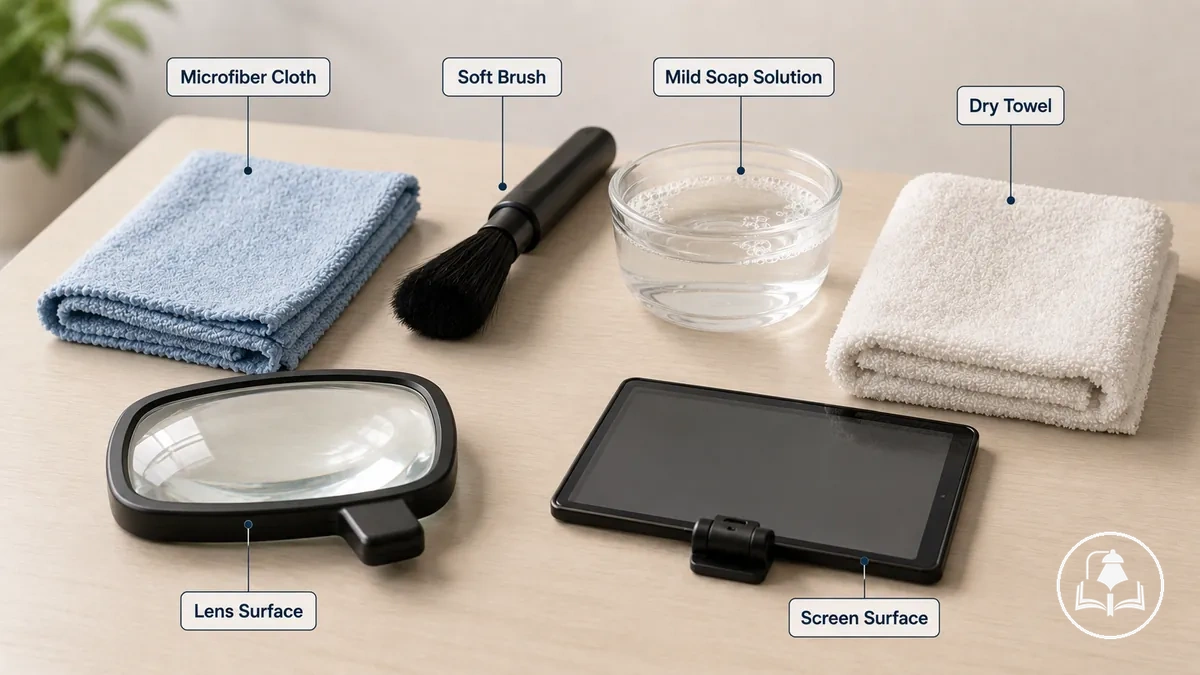
For electronic, coated, or mixed-material reading accessories, surface sensitivity can vary significantly. Light handling and minimal moisture are preferred, and manufacturer instructions should be followed when specific care limits are provided.
- Microfiber cloth → Used for lenses, screens, and coated surfaces → Risk avoided: scratching and smudge buildup when used dry or lightly
- Soft brush → Used for seams, grooves, and textured areas → Risk avoided: debris buildup and forced residue in tight spaces
- Mild soap → Used with diluted solution for washable hard surfaces → Risk avoided: heavy staining and residue from strong cleaners
- Damp cloth → Used for controlled wipe-down of rigid materials → Risk avoided: excessive moisture exposure and surface abrasion
- Dry dusting → Used for fabric and foam components → Risk avoided: moisture damage and deformation of absorbent materials
- Surface-safe wipe → Used for coated finishes with compatibility → Risk avoided: coating disruption and residue buildup
Microfiber Cloths, Soft Brushes, and Mild Soap
Microfiber cloths, soft brushes, and mild soap are used for gentle dust, smudge, seam, groove, and washable surface care in reading accessories. These tools reduce abrasion by limiting harsh contact and controlling residue buildup. Moisture must always match the surface condition to avoid residue and moisture damage.
A microfiber cloth is typically used for lifting dust and smudges from smooth areas, while a soft brush reaches into seams and grooves where crumbs and debris collect. Mild soap is only appropriate for washable surface conditions where moisture-safe handling does not affect structure or coating. Each tool operates within specific surface limits rather than a full cleaning process.
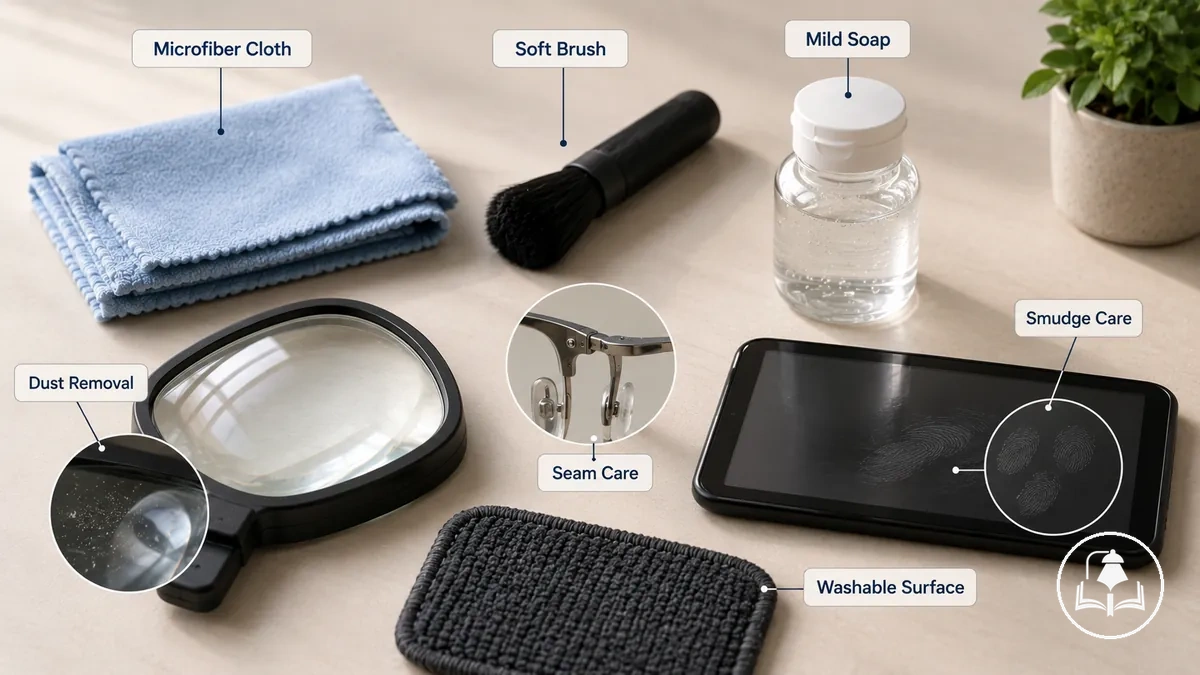
- Microfiber cloth → suited for dust and smudge removal on lens and screen surfaces → caution: avoid excess pressure that may increase scratching risk on coated areas
- Soft brush → suited for cleaning seams and grooves where debris collects → caution: avoid moisture use in non-moisture-safe or absorbent materials
- Mild soap → suited for washable surface cleaning with controlled damp application → caution: avoid use on electronics or absorbent filling where residue or moisture damage may occur
Cleaners and Wipes That Can Damage Surfaces
Damage to reading accessories usually comes from cleaner strength, abrasion, or excess moisture interacting with sensitive materials. Coatings, fabrics, lenses, and screens react differently depending on exposure level and surface condition. This means risk is not only about the cleaner itself but also about the material it contacts.
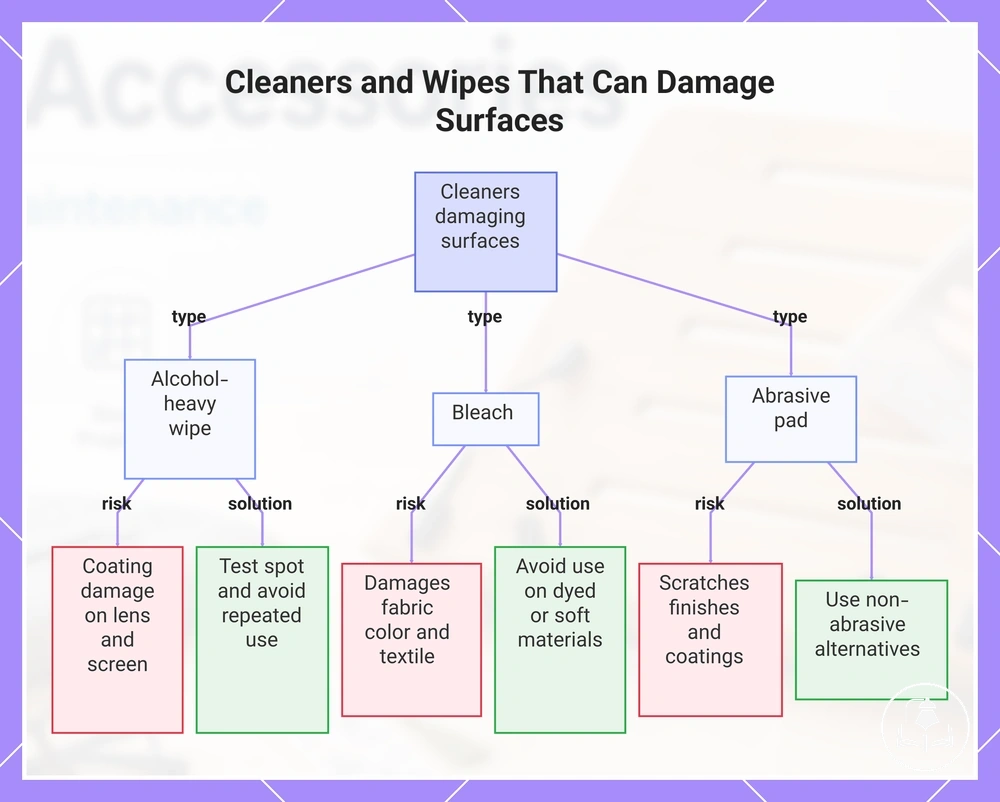
A wipe or spray that works on one surface may not be suitable for another because coatings, adhesives, and fabrics respond differently to chemical strength and moisture levels. This is why a test spot and manufacturer instructions matter before applying any cleaner broadly. The checklist below highlights cleaner types that can create higher risk depending on surface sensitivity.
- Alcohol-heavy wipe → can affect coating on lens and screen surfaces → safer response: test spot first and avoid repeated use on sensitive finishes
- Bleach → can damage fabric color and weaken textile structure → safer response: avoid use on dyed or soft materials due to staining risk
- Abrasive pad → can scratch finishes and protective coatings → safer response: use only non-abrasive alternatives for coated or polished surfaces
- Soaking → can weaken adhesive areas and saturate seams or filling → safer response: avoid immersion and control moisture exposure carefully
- Strong solvent → can interact with coatings and plastic surfaces → safer response: check compatibility and apply only when surface tolerance is confirmed
- Excess water → can affect electronics, fabric absorption, and internal residue buildup → safer response: use minimal damp cleaning instead of wet cleaning
- Fragranced spray / residue-heavy cleaner → can leave buildup on fabric and coated surfaces → safer response: ensure residue-free formulation and test on small area first
This chart shows common cleaner types that can damage surfaces, their specific risks, and recommended safer responses.
How to Clean Reading Accessories by Surface Type
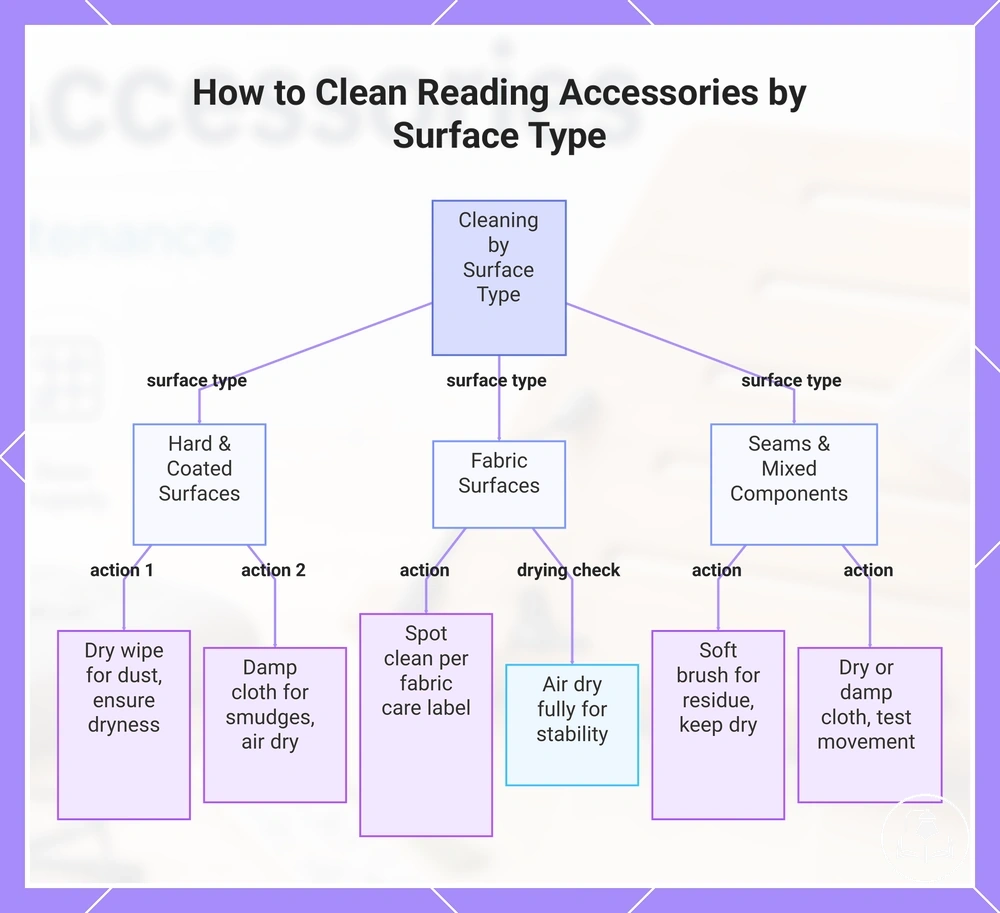
Cleaning reading accessories depends on surface type and moisture tolerance rather than a single universal method. Hard surfaces, fabrics, coatings, and electronics respond differently to wipe, brush, dry, and damp cloth actions. This surface-led approach helps reduce dust, smudge, grime, and residue without overexposing materials to moisture. The method below organizes cleaning by surface type for controlled application. :contentReference[oaicite:0]{index=0}
Dust, smudge, grime, and residue build up differently across reading accessories, so each condition needs a specific cleaning action. A dry wipe may be enough for light dust on hard surfaces, while smudges on coated areas often need a controlled damp cloth. Fabric materials respond better to spot clean approaches guided by a fabric care label, while grooves and seams often require a soft brush. These differences require adapting pressure, moisture, and drying steps to avoid surface stress. The steps below outline how to handle each surface type safely.
Mixed reading accessories such as clips, hinges, lenses, and covers combine multiple surface types in one structure. Each area may require a different cleaning action, especially where moving parts or coated finishes are present. Always check moisture tolerance before applying any damp method, and adjust based on fabric care label or material sensitivity. For correct assembly context before maintenance, refer to reading accessories setup as a baseline reference for structure awareness.
- Hard surface (dust) → Use a dry wipe to remove dust from rigid areas → drying check: ensure no moisture remains on the surface
- Coated surface (smudge) → Use a lightly damp cloth to lift smudges from lenses or screens → drying check: air dry to prevent moisture streaks
- Fabric surface (grime) → Use spot clean based on fabric care label guidance → drying check: air dry fully to maintain fabric stability
- Seam and groove areas (residue) → Use a soft brush to loosen residue from tight spaces → drying check: keep area dry to prevent buildup
- Mixed components (hinge or clip) → Clean carefully with dry or minimally damp cloth depending on moisture tolerance → drying check: test movement after drying
This chart shows how to clean reading accessories based on surface type, with specific cleaning actions and drying checks for hard, coated, fabric, seams, and mixed components.
Book Lights, Lenses, and Screen-Based Accessories
Book light, lens, and screen-based accessories require low-moisture cleaning because their performance depends on coating sensitivity and protected electronic areas. A book light or screen-based tool can collect dust and smudge during use, and cleaning should stay controlled with a microfiber cloth and minimal moisture tolerance. Charging port, seam, and coated surfaces require caution because liquid exposure can affect sensitive internal areas.
- Power off when applicable → Switch off the book light or screen-based tool before cleaning → drying check: ensure all surfaces are fully dry before reuse
- Dry dust removal → Use a dry wipe to remove dust from the book light body, clip, and flexible neck areas → drying check: confirm no residue remains on outer surfaces
- Lens and screen wipe → Use a microfiber cloth to gently remove smudge from lens and screen surfaces with coating sensitivity → drying check: ensure a streak-free dry finish without liquid residue
- Avoid charging port exposure → Keep charging port and seam areas dry due to moisture tolerance limits → drying check: inspect visually without applying liquid into openings
- Clip and flexible neck check → Use a dry brush to remove grime from clip and hinge areas → drying check: confirm smooth movement without residue buildup
Book Stands, Holders, and Hard Support Surfaces
Book stands, holders, and hard support surfaces collect residue around contact points and moving areas such as joints, hinges, clips, and grooves. This buildup can influence grip, stability, and movement over time, especially where repeated handling creates localized friction. Cleaning these surfaces focuses on removing dry dust and residue without disturbing structural contact points that support stable positioning.
In some cases, adjustable book stand or holder designs may react to pressure or moisture around joints and non-slip pad areas, which can affect movement or surface contact behavior. Page holders and similar tools can also vary in sensitivity depending on how contact points are designed. These areas require careful dry handling because moisture near metal parts or adhesive pads may alter surface response.
For page holders or related marking tools, surface interaction can be seen in page tracking accessories where contact pressure affects handling points and surface control.
- Hard support surface wipe → Use a dry wipe to remove dust and residue from book stand surfaces → helps maintain grip without affecting contact stability
- Groove and hinge cleaning → Use a dry brush to clear residue from joints, hinges, and grooves → reduces buildup in movement areas without forcing debris
- Non-slip pad care → Wipe non-slip pad areas dry to preserve grip → moisture can reduce surface stability over time
- Clip and joint cleaning → Use a soft dry brush on clips and moving parts → helps reduce residue without disturbing alignment
- Metal contact areas → Keep metal parts dry and gently remove residue → moisture exposure may affect long-term stability at contact points
Book Sleeves, Reading Pillows, and Fabric Accessories
Fabric accessory care depends on care label, cover material, filling, and stitching, especially for items like a book sleeve or reading pillow where structure and softness interact. A fabric accessory is typically cleaned using spot cleaning, lint removal, and gentle hand cleaning methods that protect the cover material and internal filling. Air dry is preferred to maintain shape and stitching stability, while soaking should be avoided when filling or structure may be affected.
In travel or daily carry situations, a book sleeve or padded item may collect odor, surface grime, or light deformation depending on use conditions, especially when used alongside portable accessories. Cleaning choice in these cases depends on whether the cover material is removable and how the filling reacts to moisture exposure.
- Spot cleaning → Use localized gentle cleaning on stains in cover material → risk: over-wetting may spread residue into filling
- Lint removal → Remove surface dust and fibers from stitching and fabric sleeve areas → risk: excessive friction may weaken delicate stitching
- Gentle hand cleaning → Clean removable covers when care label allows controlled washing → risk: mismatch with care label may affect colorfastness
- Air dry → Dry flat to preserve shape of reading pillow and padded structure → risk: heat or fast drying may distort filling
- Seam and zipper care → Clean stitching and zipper areas with dry handling → risk: moisture trapped in seams may lead to uneven drying
How to Keep Reading Accessories Clean Between Uses
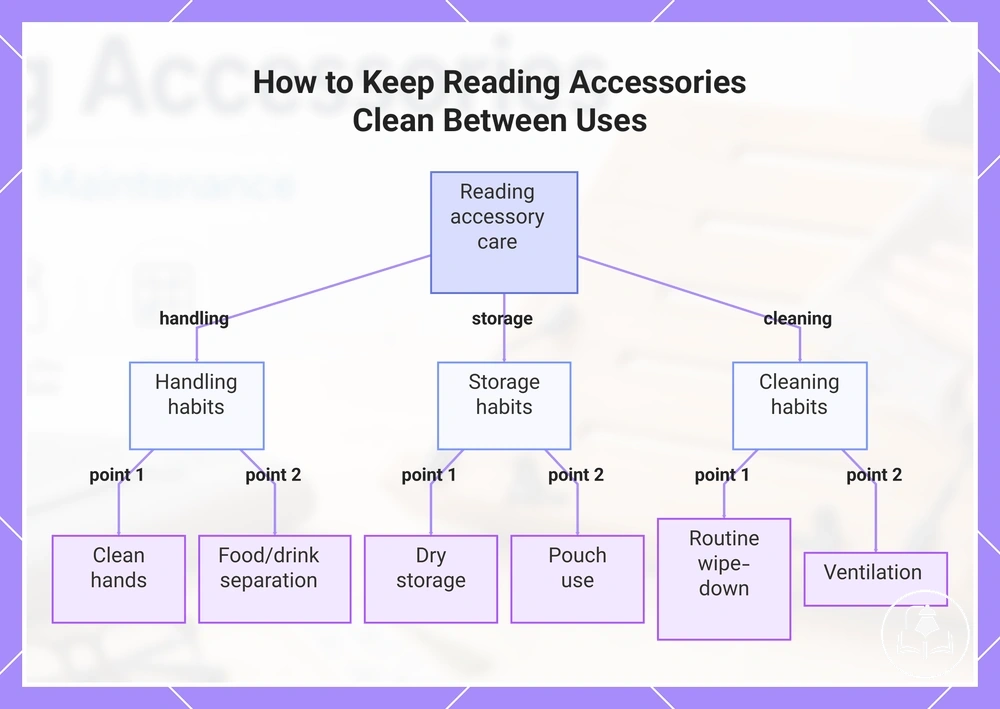
Reading accessories stay cleaner between uses when they are handled with clean hands, kept in dry storage, and protected through basic dust control and residue awareness. Between uses habits such as limiting contact with food and drink surfaces and reducing exposed placement help slow down residue buildup. These practices can lower the need for frequent deep cleaning by maintaining more stable surface conditions over time.
Between uses care changes depending on the household environment, including home, desk, bed, or travel situations, where dust control and ventilation levels vary. A pouch can help protect items in portable use, while dry storage supports fabric and electronic-sensitive accessories in stable conditions. Routine wipe-down habits may be used depending on handling frequency, especially where residue or moisture exposure is more likely. Boundary cue: persistent structural or handling issues fall under reading accessory problems rather than between-uses maintenance.
How to Keep Reading Accessories Clean Between Uses checklist helps verify handling, storage, and drying habits that reduce residue buildup and surface contamination.
- Clean hands → reduces transfer of food, drink, and skin residue onto surfaces
- Dry storage → lowers moisture exposure that can attract dust or residue
- Pouch use → protects items from household environment dust and contact contamination
- Food and drink separation → prevents stains and sticky residue buildup during handling
- Ventilation → helps reduce trapped moisture in fabric or padded accessories
- Routine wipe-down → removes light residue before it accumulates into deeper buildup
This chart shows the key between-uses practices to reduce residue buildup and surface contamination on reading accessories.
Drying, Dust Control, and Short-Term Storage After Cleaning
Damp or dusty short-term storage can undo cleaning by reintroducing moisture and dust onto already cleaned surfaces. Drying is the key condition that determines whether reading accessories remain stable before reuse, with air dry and towel blotting helping reduce residual dampness. Short-term storage must account for drying status and dust control to prevent immediate re-contamination from dust source environments.
Drying, dust control, and short-term storage after cleaning require immediate checks to confirm that moisture and exposure risks are reduced before reuse. This is especially important when handling absorbent padding, electronics, or hinge-based accessories where retained dampness can vary by material thickness and structure. The checklist below outlines basic post-cleaning checks for stability before next use.
- Air dry → helps reduce trapped moisture in fabric, padding, and coated surfaces → risk: retained dampness in absorbent padding
- Towel blotting → removes surface moisture before full drying → risk: leftover damp spots in seams or hinges
- Avoid sealed storage while damp → prevents moisture buildup in closed environments → risk: residue or odor concentration in enclosed conditions
- Keep away from dust source → reduces immediate re-contamination after cleaning → risk: dust settling on freshly cleaned surfaces
- Separate cleaned cloth → prevents transferring residue back onto cleaned items → risk: cross-contamination from used cleaning materials
Care for Cleaning Cloths and Small Maintenance Tools
Cleaning cloth, microfiber, and soft brush maintenance tools must be clean and dry before they touch reading accessories, because lint, residue, or trapped dirt can transfer back onto surfaces. A dirty cleaning cloth or worn maintenance tool may reintroduce contamination, especially after use on a greasy surface or abrasive surface. This transfer risk can affect how effectively a surface is cleaned and may lead to smearing or light re-soiling depending on conditions and pressure.
For example, a microfiber cloth that has collected grease or fine particles can smear or drag residue when reused on a lens or coated surface, and in some cases may contribute to light scratching when abrasive particles are present. This shows why maintenance tool hygiene directly affects cleaning outcomes across different reading accessories.
- Microfiber → wash separately when it collects lint or residue → risk reduced: cross-contamination from mixed wash cycles
- Cleaning cloth → dry fully before reuse → risk reduced: moisture-related residue transfer onto surfaces
- Soft brush → store dry and free from dust buildup → risk reduced: redepositing dust onto cleaned accessories
- Maintenance tool → replace or clean when visibly dirty → risk reduced: persistent smear and residue transfer
- Wipe → avoid reuse on greasy surface areas → risk reduced: grease transfer and abrasive contamination
Maintenance Checks That Protect Accessory Lifespan
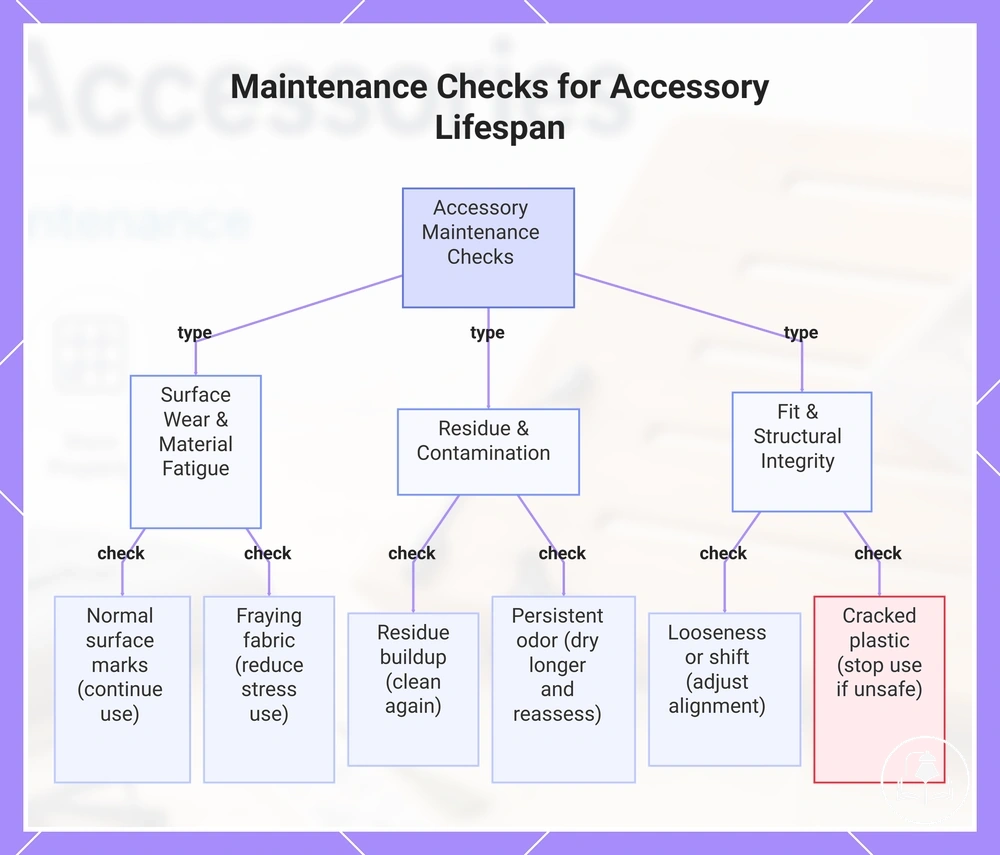
Maintenance check refers to observing each accessory part to identify visible condition signs that affect safe use and lifespan. These checks focus on wear, residue, looseness, and functional changes that may appear after cleaning or handling. The purpose is to connect visible condition directly to usability so decisions can be made based on real surface and structural signals.
Some accessory part conditions require immediate adjustment such as cleaning again, drying longer, or reducing use when instability appears. Signs like residue buildup, mechanical resistance, or material fatigue can affect performance and safety if ignored. In clearer cases, stopping use may be necessary when the condition suggests risk to function. These visible condition signals help distinguish routine wear from issues that need separate fit or problem-solving attention, leading into the checklist below.
Maintenance checks that protect accessory lifespan also support long-term practical use by aligning visible condition with continued usability, directly affecting value and lifespan.
- Wear → accessory part shows surface use marks → condition: normal aging → action: continue use if stable
- Residue → visible buildup remains after cleaning → condition: incomplete cleaning → action: clean again
- Looseness → accessory part shifts during handling → condition: reduced fit stability → action: adjust alignment
- Stuck hinge → movement becomes restricted → condition: friction or blockage → action: dry longer or clear residue
- Fraying fabric → fibers weaken or separate → condition: material wear → action: reduce stress use
- Cracked plastic → visible structural break → condition: weakened integrity → action: stop use if instability affects safety
- Weak clip → reduced holding strength → condition: mechanical fatigue → action: test before continued use
- Unstable stand → imbalance during placement → condition: support failure → action: adjust or avoid load
- Persistent odor → smell remains after cleaning → condition: trapped residue or moisture → action: dry longer and reassess
This chart categorizes common accessory maintenance checks and the recommended actions based on visible condition signs.
Cleaning Mistakes That Shorten Accessory Lifespan
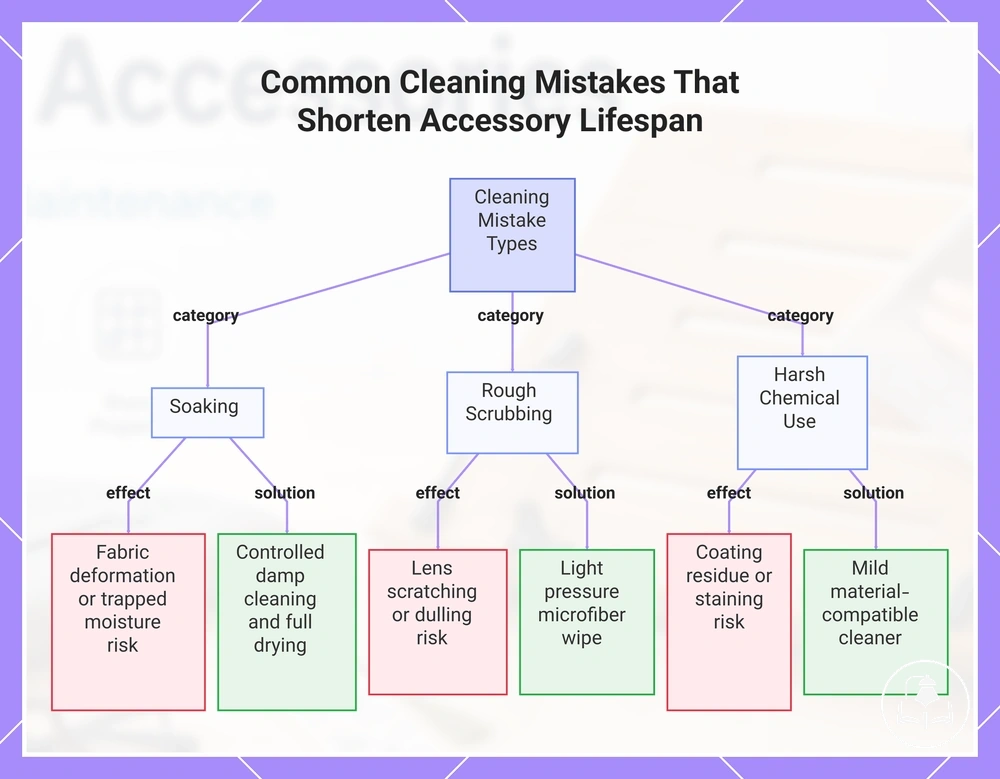
Most cleaning mistake patterns come from too much moisture, abrasion, pressure, or using a wrong cleaner for the material. These damage risks affect reading accessories differently depending on construction, especially where fabric, coatings, electronics, and moving parts are involved. The main risk groups include soaking, rough scrubbing, and harsh chemical use, which can influence visible condition and useful life over time.
Stronger cleaning is not always safer for delicate surfaces because higher force or stronger solutions do not guarantee better results. In some cases, over-wetting, pressure, or mismatched cleaning methods can increase damage risk instead of improving cleanliness. The warnings below show how specific cleaning errors may affect accessory parts and why safer alternatives are usually more appropriate for maintaining lifespan.
- Soaking → accessory part: fabric or padded filling → risk: deformation or trapped moisture → safer alternative: controlled damp cleaning and full drying
- Scrubbing coated surfaces → accessory part: lens or protective coating → risk: surface scratches or dulling → safer alternative: light pressure microfiber wipe
- Harsh chemical use → accessory part: coated or plastic surfaces → risk: residue or staining on coating → safer alternative: mild material-compatible cleaner
- Sealing damp fabric → accessory part: textile or padding → risk: moisture trapping and odor development → safer alternative: air dry before storage
- Spraying directly onto electronics → accessory part: electronic components or ports → risk: internal moisture exposure → safer alternative: apply cleaner to cloth first
- Ignoring care label → accessory part: fabric-based items → risk: incorrect wash or drying behavior → safer alternative: follow material guidance when available
- Forcing moving parts → accessory part: hinge or clip mechanism → risk: looseness or mechanical stress → safer alternative: gentle cleaning and alignment check
This chart shows the three main cleaning mistake risk groups—soaking, rough scrubbing, and harsh chemical use—along with their typical effects and safer alternatives.