

Reading Accessories for Visibility and Focus
Reading accessories for visibility and focus are reading-support tools that can make printed pages easier to see, follow, or stay with in specific reading situations. They matter when page clarity depends on light, print size, reading distance, or how easily attention stays on one line of text. A book light, line guide, focus ruler, or magnifier can support different reading needs depending on the situation. Visibility and focus are the main reading-support frame for this page.
In low-light reading, during longer sessions, or when reading small print, the reading situation often determines which type of support may be helpful. A page may benefit from improved page illumination, reduced glare, clearer text enlargement, or more consistent line tracking. These reading conditions are distinct: low light affects page visibility, small print affects clarity, and line distraction affects focus without requiring the same type of support.
When reading becomes harder because text is difficult to see or easy to lose across the page, the most useful solution usually starts with identifying the reading condition. Reading accessories can support visibility, focus, and page clarity, but they cannot promise medical or learning outcomes. The next section establishes the foundation for understanding lighting, light quality, line tracking, and magnification in greater detail.
How Visibility and Focus Accessories Improve the Reading Page
Visibility accessories and focus accessories are tools that help readers see, track, or concentrate on printed text more comfortably. They support page clarity by addressing reading conditions such as low light, small print, or difficulty maintaining attention on a line of text. Their main function is to make printed text easier to see, follow, or focus on.
How Visibility and Focus Accessories Improve the Reading Page becomes clearer when each tool is connected to the page attribute it supports. The image below illustrates how different accessory groups contribute to seeing, tracking, and concentrating on printed text.

reading accessories include reading lights, line guides, focus rulers, and magnifiers that support different reading conditions. Reading lights improve page illumination and may support clarity in low-light reading. Line guides and focus rulers support line tracking by helping attention remain on the intended line of printed text. Magnifiers enlarge small print and may improve clarity when reading distance or text size makes details harder to see.
These accessory groups describe broad functions rather than detailed selection criteria. For a wider classification of categories, see reading accessory types. Feature comparisons, sizing considerations, and selection methods are addressed in later sections.
Visibility accessories and focus accessories support reading conditions, but they do not replace professional vision assessment when reading difficulty is persistent or extends beyond page clarity, line tracking, or small-print visibility.
Book Lights for Low-Light Reading
When ambient light is weak, uneven, or poorly positioned, page visibility can decrease because printed text is not illuminated clearly. Book lights provide focused illumination that helps direct light onto the reading surface where it is needed most. Low-light reading is an illumination issue rather than a product choice.
Book Lights for Low-Light Reading depend on how light reaches the page. The image below demonstrates how lamp placement and page coverage influence the illuminated reading area.

Book lights differ by how they deliver light to the page. A clip-on light attaches directly to reading material and may provide stable page coverage during bedtime reading, travel, or use away from a desk. Beam angle affects where light falls on the page, while brightness influences how clearly text stands out from its background. In a shared space, a narrower beam may reduce light spread, while a wider beam may illuminate more of the reading area.
Power source and adjustability influence how a book light fits a reading environment. A rechargeable reading light may suit longer sessions when charging is practical, while battery-powered options may be preferred when portability is important. Adjustable positioning can help direct illumination toward the page and away from reflective surfaces. Glare, shadows, and reading comfort often depend on beam angle, page position, surrounding light conditions, and personal preference.
Book lights differ by placement, power, and light-control attributes. The table below highlights common factors that can affect page visibility in different low-light reading situations.
| Book light factor | What to check | Why it matters | When it matters most |
|---|---|---|---|
| Placement | Light position relative to the page | Influences page coverage and shadow control | Bedtime reading and travel |
| Brightness | Available light output levels | Supports page visibility in dim conditions | Low-light reading |
| Power source | Rechargeable or battery-powered operation | Affects session length and convenience | Extended reading sessions |
| Adjustability | Beam angle and lamp positioning | Helps direct illumination toward the reading area | Changing reading positions |
| Glare control | Light spread and reflection management | May improve reading comfort | Shared spaces and reflective pages |
Clip-On Book Lights and Page Coverage
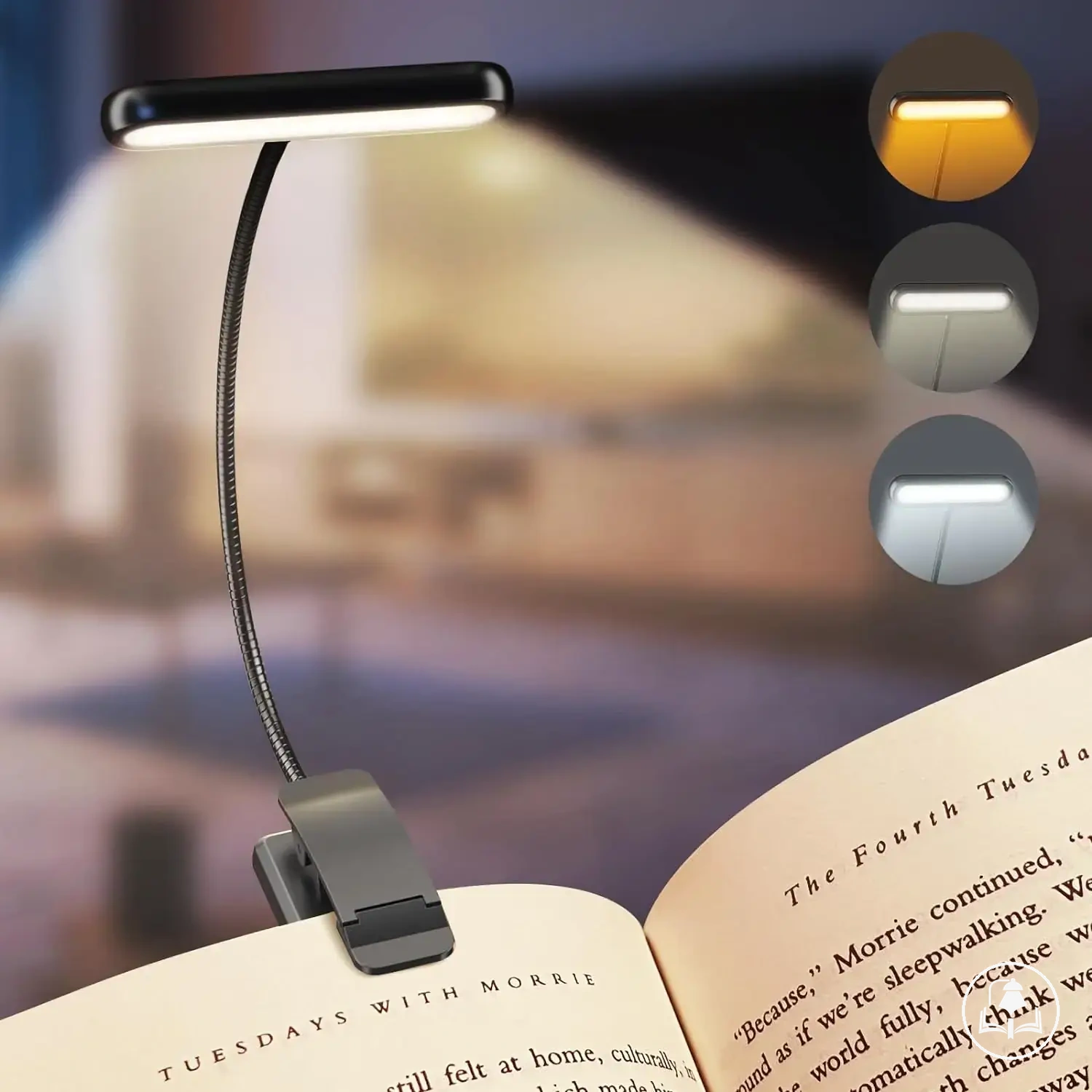
When reading in bed, on a sofa, or in another low-light setting, a clip-on book light directs illumination to the page by attaching to a book, cover, or nearby surface. The attachment point affects how securely the light stays in place and where the beam reaches the text. Page coverage depends on both attachment and beam spread.

Clip-on book lights use a clip mechanism to hold the light in position while directing illumination toward the reading area. Clip strength may influence stability when the book is moved or repositioned. A flexible neck allows the beam angle to be adjusted so light reaches more of the page and may reduce shadows along the text. Beam spread affects how much of the page is illuminated at one time, which can influence page coverage on different page sizes.
Page coverage depends on attachment and beam control. When evaluating a clip light, these factors are often the most relevant:
- Attachment point: determines where the light can be positioned.
- Clip strength: may influence stability during reading.
- Beam spread: affects how much of the page receives illumination.
- Flexible neck: helps direct light toward the intended reading area.
Cover thickness can affect fit and positioning. Thick hardcovers may require a different attachment point than slim paperbacks, and page coverage may vary when the light is positioned closer to or farther from the reading surface. In shared-bed reading situations, beam direction and attachment placement may also influence how much light extends beyond the page.
Rechargeable and Adjustable Reading Light Features
Rechargeable and adjustable reading light features matter most when reading frequency, charging habits, and session length match the intended routine. A rechargeable reading light can reduce dependence on disposable batteries, while an adjustable reading light can provide greater control over light placement. These features influence convenience, light control, and reliability during repeated low-light reading sessions.
Feature value depends on reading routine and light-control needs:
- Battery life: May be more important when reading sessions occur frequently or when charging opportunities are less convenient.
- Charging method: A USB rechargeable light may suit routines that already include regular device charging.
- Brightness levels: Multiple brightness levels can help adapt illumination to different page conditions and reading environments.
- Beam angle: An adjustable beam angle may improve light placement when reading position or page orientation changes.
- Flexible neck: A flexible reading light can allow more precise beam control, which may help manage shadows and light direction.
Rechargeable and adjustable features often involve a balance between convenience and control. A rechargeable reading light may suit frequent reading only when charging habits support the expected session length, while adjustable controls may be more useful when reading locations, page sizes, or lighting conditions vary between sessions.
This chart shows how the importance of reading light features varies with usage context, focusing on rechargeable and adjustable attributes and the convenience-control balance.

Neck Reading Lights for Hands-Free Illumination
When reading in low-light conditions and keeping both hands available is important, a neck reading light can provide hands-free illumination by directing light toward the page from a wearable position. A neck reading light rests around the neck rather than attaching to the book or nearby surface. Neck placement is the main distinction between a neck reading light and a clip-on light.
Neck reading lights depend on wearable fit and beam control for effective page visibility:
- Beam direction: Adjustable beam direction may help keep light focused on the reading area as page position changes.
- Neck comfort: Neck comfort can influence suitability across different session lengths.
- Weight: Weight may affect how practical a wearable reading light feels during extended use.
- Shared-space reading: A directed beam may limit light spread beyond the page during shared-space reading.
- Page coverage: Page coverage depends on beam placement, reading distance, and page size.
A wearable reading light directs illumination from the reader's position rather than from the book itself. Compared with clip-on lights, the difference is placement rather than performance superiority. Hands-free illumination may be useful when reading material moves frequently, but coverage and shared-space suitability depend on beam control, fit, and reading conditions.
This chart explains what a neck reading light is, its key design features, and the performance factors that affect hands-free reading.

Light Quality Factors for Eye Comfort
Eye comfort depends on how light quality matches the reading environment and the conditions in which reading takes place. Brightness, colour temperature, glare, shadow, and flicker can influence visual comfort and page visibility, but their effects often vary by preference, page surface, and surrounding light. These comfort factors relate to reading conditions rather than medical outcomes.
Light quality factors affect how clearly text appears and how comfortable a reading session may feel. Brightness describes light intensity and may influence visibility when a page appears too dim or overly illuminated. Colour temperature describes whether light appears warmer or cooler, and preference for warm light or cool light often varies by reader and environment. Glare and shadow can reduce page visibility when reflections, beam angle, or page surface characteristics interfere with reading. Flicker is a light quality characteristic that may affect comfort for some readers depending on sensitivity and viewing conditions.
The reading environment can change how these factors are experienced. In dark rooms, brightness and beam control may become more noticeable because contrast between the page and surrounding area is greater. Reflective pages can make glare more apparent, while shadows may become more visible when light reaches the page from a narrow angle. During long sessions or in shared spaces, lighting comfort may depend on balancing visibility, light spread, and personal preference rather than maximizing a single light attribute.
Light comfort depends on both the light source and the reading environment. The table below summarizes common light quality factors and the reading conditions they may influence.
| Light quality factor | Reader should check | Possible comfort effect | Use-case note |
|---|---|---|---|
| Brightness | Whether the page appears clearly illuminated | May influence visibility and eye comfort | Often relevant in dark rooms |
| Colour temperature | Preference for warm light or cool light | May affect lighting comfort | Depends on environment and reader preference |
| Glare | Reflections on the page surface | May create reading friction | More noticeable on reflective pages |
| Shadow | Beam angle and page surface conditions | May reduce visibility | Relevant when light direction changes |
| Flicker | Consistency of light output | May affect comfort under certain conditions | Varies by sensitivity and environment |
Brightness, Colour Temperature, and Glare Control
Brightness, colour temperature, and glare control influence how comfortably a page can be seen under different reading conditions. When these light-quality variables align with the reading environment, visibility may improve and reading friction may be reduced. The three variables are brightness, colour temperature, and glare control.
Brightness describes light intensity and affects how clearly text appears on the page. In a dark room, higher brightness may improve visibility, but excessive brightness can increase glare risk on reflective pages. Colour temperature describes whether light appears as warm light or cool light, and preference often depends on the reading environment and the reader. Glare control relates to managing reflections, while diffused light may reduce harsh reflections compared with direct light in certain conditions.
The comparison below separates lighting conditions rather than product quality.
| Condition | Possible reading effect |
|---|---|
| Too dim | May make page details harder to see in low-light conditions |
| Too bright | May increase glare risk on reflective pages |
| Warm light | May be preferred in certain reading environments |
| Cool light | May improve perceived page contrast for some readers |
| Direct light | May create glare or shadow depending on beam angle and page surface |
| Diffused light | May provide more even page illumination in certain conditions |
Beam angle can influence both glare control and shadow placement. For example, adjusting the beam angle away from a reflective page may reduce visible reflections, while a different angle may help limit shadows across the reading area.
Reading Line Guides and Focus Rulers
Reading line guides and focus rulers are reading-support tools that help readers follow text across a page more consistently. They work by highlighting, revealing, or isolating part of the text so attention can remain on the intended reading area. Their primary support function is line tracking.
A reading line guide or focus ruler can differ by window size, opacity, colour, and ruler length. A window guide reveals only a selected portion of text while masking surrounding lines, which may help reduce visual distraction in certain reading situations. A coloured overlay or overlay ruler changes how text is viewed on the page and may be preferred when readability depends on personal preference. Ruler length influences how much of a line remains visible and can affect page orientation while reading.
Focus tools differ by how much text they reveal or mask. The comparison below highlights these differences rather than indicating product quality.
| Focus support | Not the same as |
|---|---|
| Window guide reveals a selected reading area | Page marking or annotation |
| Coloured overlay may change page appearance | Permanent highlighting |
| Reading line guide supports line tracking | Bookmarking or page organization |
When skipped lines, loss of page orientation, or visual distraction occur, a focus ruler, reading ruler, line marker, or focus strip may help maintain reading flow by keeping attention on a narrower section of text. Results can vary by page layout, text density, and individual preference. Topics related to page tracking and marking, including note-taking and broader organization methods, belong outside this section unless they directly affect focus during reading.
Line Tracking, Visual Stress, and Page Distraction
When losing place, skipping lines, or becoming distracted by surrounding text interrupts reading flow, a reading guide may provide localized support. Line tracking tools work by narrowing attention to a selected portion of the page rather than changing the text itself. They may help maintain line focus in some reading situations, but support can vary by reader and reading condition.
Masking, colour, and ruled-edge attributes influence how a guide is used. A masking feature reduces the amount of surrounding text that remains visible, which may help when page distraction occurs. A coloured guide or coloured overlay may be preferred when visual stress or readability concerns relate to personal comfort and viewing preference. A ruled edge provides a visible boundary that can support text tracking and page position awareness while reading.
The checklist below organizes common tracking frictions and the guide attributes that may provide support:
- Losing place: A ruled edge or reading guide may help maintain line tracking.
- Skipped lines: Masking may reduce attention shifts between adjacent lines.
- Surrounding-text distraction: A windowed viewing area may limit visible text outside the reading line.
- Colour preference: A coloured guide may be preferred when page comfort depends on individual viewing preference.
If visual stress, recurring discomfort, or reading difficulty continues despite using a guide, contributing factors may extend beyond page distraction or line tracking alone. Reading accessories provide reading support, but they are not intended to diagnose or address underlying causes of persistent reading difficulty.
This chart shows the key attributes of reading guides and how they address common line tracking frictions and visual stress concerns.

Physical Rulers, Overlays, and Digital Reading Rulers
Physical rulers, coloured overlays, and digital reading rulers support the same line-tracking need, but the most suitable format depends on reading medium, portability requirements, and preferred text masking behavior. Each format approaches focus support differently rather than serving as a universal solution. Medium, portability, adjustability, and masking are the main comparison variables.
| Format | Main attribute | Trade-off | Best use case |
|---|---|---|---|
| Physical ruler | Defined reading edge and direct page alignment | May require manual repositioning during reading | Printed-page reading where portability and simple line tracking are priorities |
| Coloured overlay | Colour preference and text masking support | Effectiveness may vary by reader preference and page conditions | Reading situations where surrounding text or page appearance affects focus |
| Digital reading ruler | Adjustability and movable screen ruler boundaries | Limited to screen-reading environments | Digital reading where adjustable text masking is preferred |
A physical ruler or reading strip may suit page use because it is easy to move between books and documents, though repositioning can interrupt reading flow. A coloured overlay or focus overlay may be preferred when colour preference and text masking influence visibility or comfort. A digital reading ruler provides adjustable boundaries during screen reading, but its use depends on a digital environment rather than a printed page. The best use case for each format depends on reading environment, portability needs, and preferred level of text masking.
Page Magnifiers for Clearer Text
Page magnifiers are reading tools that enlarge printed text to make details easier to see when small print, low contrast, or page clarity issues make reading more difficult. A page magnifier changes the apparent size of text rather than changing the printed material itself. Magnification can support clearer text when print size or contrast difficulty affects readability.
Page magnifiers differ by format, magnification strength, field of view, and holding position. A full-page magnifier or magnifying sheet covers a larger reading area, while a bar magnifier focuses on a narrower section of text. Magnification strength influences how much text is enlarged, while field of view affects how much text remains visible at one time. Reading distance and positioning can influence usability, and higher magnification may involve a trade-off between enlargement and visible reading area. Distortion may become more noticeable depending on magnifier format, strength, and viewing position.
A reading magnifier may be useful when small print in labels, paperbacks, instructions, or other printed materials is difficult to read at a comfortable reading distance. A hands-free magnifier may suit longer reading sessions when maintaining a consistent viewing position is preferred. The most suitable format often depends on print size, page layout, reading distance, and the amount of text a reader wants to view at one time.
Magnifiers differ by how much text they enlarge and how they are held or positioned. The table below summarizes factors that may influence clarity and usability.
| Magnifier factor | What changes | Reader check | Possible limitation |
|---|---|---|---|
| Format | How text is viewed and supported | Page size and reading task | May suit certain reading conditions better than others |
| Magnification strength | Amount of enlargement | Print size and readability needs | Higher enlargement may reduce visible text area |
| Field of view | Amount of text visible at once | Line length and page layout | Smaller viewing area may require more repositioning |
| Reading distance | Viewing position relative to text | Comfort and page visibility | Usability may vary with positioning |
| Handling | How the magnifier is held or supported | Session length and reading style | May affect convenience during extended use |
Full-Page, Bar, and Hands-Free Magnifier Formats
Full-page magnifier, bar magnifier, and hands-free magnifier formats differ mainly in how much text they show at once and how they are handled during reading. Each format changes page visibility and reading interaction without changing the printed content. Format affects both field of view and handling requirements.
A compact comparison helps show how magnifier format influences visible text area, stability, and portability.
- Full-page magnifier: A full-page magnifier or magnifying sheet provides a wider field of view and may suit larger page size formats when viewing more text at one time is preferred. Portability depends on size, and handling may require repositioning as reading progresses.
- Bar magnifier: A bar magnifier or reading bar focuses on a narrow section of text and may support line focus for small print. Its portability can make it practical for books, labels, and other compact reading materials, although the visible area remains limited.
- Hands-free magnifier: A hands-free magnifier or stand magnifier may provide greater stability because the viewing position remains supported rather than handheld. It may suit reading conditions where reading posture or keeping both hands free is important.
Format choice depends on page size, reading posture, and handling preference. A larger page size may benefit from a wider field of view, while a hands-free magnifier may be more suitable when stability is prioritized. Portability, stability, and visible text area are most useful when considered together.
Magnification Strength and Reading Distance
Magnification strength depends on the balance between enlarged text, reading distance, and field of view rather than on using the highest magnifier power available. Stronger magnification may make small print easier to see, but it can also change how much visible text remains on the page. The main trade-off is that stronger magnification can reduce visible text area.
Magnification strength, reading distance, field of view, and distortion work together. As magnification strength increases, enlarged text may become easier to distinguish, but viewing distance and visible text amount can change at the same time. A smaller field of view may require more page scanning, while distortion may become more noticeable depending on the viewing condition and magnifier position. The checklist below helps verify whether magnification strength matches print size, distance, and visible text needs.
- Print size: Check whether small print is large enough to read comfortably.
- Holding distance: Verify that the reading distance remains practical for the reading position.
- Distortion: Check whether text remains clear across the visible reading area.
- Line visibility: Confirm that enough visible text remains for comfortable page scanning.
For example, higher magnification may help with very small print by creating larger text, but the visible line length may become shorter at the same time. The most suitable balance depends on print size, reading distance, field of view, and the usability trade-off created by stronger magnification.
Choosing Visibility Accessories by Reading Situation
Choosing visibility accessories depends on the reading situation rather than the accessory name alone. The most suitable visibility accessories and focus accessories are usually determined by the main limitation and the accessory attribute that addresses it. Selection should be based on the reading situation first.
| Reading situation | Main limitation | Accessory attribute to check | Decision outcome |
|---|---|---|---|
| Low light | Reduced page visibility | Light direction, glare control, and shared-space suitability | A book light may suit the reading condition when illumination is the primary need |
| Small print | Text size and readability | Magnification strength, reading distance, and clarity | A page magnifier may help when enlarged text is needed |
| Skipped lines | Difficulty maintaining reading position | Line guidance and visible tracking boundaries | A focus ruler or line guide may support line tracking |
| Distraction | Attention shifting across the page | Text masking and focus support | Focus accessories may help direct attention to the intended reading area |
| Long sessions | Comfort and sustained use | Comfort, tolerance, and positioning | Accessory choice may depend on maintaining usability over time |
When low light is the main limitation, the decision often depends on illumination rather than magnification or line tracking. A book light may be appropriate when page visibility is reduced, while glare control and shared-space considerations may influence the preferred option.
When small print is the primary challenge, a page magnifier may improve clarity, although reading distance and visible text area remain part of the trade-off. When skipped lines or distraction create the main reading difficulty, a focus ruler or line guide may better match the reading need. The accessory should match the dominant limitation rather than a secondary concern.
For broader selection logic across reading accessories, it can help to choose by reading need before comparing specific tools or product examples.
Visibility accessories are most useful when matched to the reading condition, main limitation, and intended decision outcome. Low light, small print, skipped lines, distraction, and long sessions each point toward different accessory attributes. Product examples can support the final choice, but the reading situation should remain the primary selection criterion.
The products below are useful examples for comparing available options. Before buying, check that the compatibility criteria, key features, and product details match your needs.


Low Light, Small Print, and Long Reading Sessions
When low light, small print, or long reading sessions change how easy a page is to use, the accessory choice should match the main friction point. Each situation calls for a different visibility-support attribute rather than the same tool. The three situations are low light, small print, and long reading sessions.
Each situation has a different primary friction point:
- Low light: Lighting control matters when dim light, glare, or shared space affects page visibility, so a directed light may suit the environment when illumination is the main limitation.
- Small print: Magnification or contrast support may help when fine print is difficult to read, but the decision should still account for reading distance and how much text remains visible.
- Long reading sessions: Fatigue-management depends on comfort, tolerance, reading duration, and handling, so the accessory should remain usable for the session rather than only solving the first visibility issue.
Conditional selection depends on environment, print size, session length, and user tolerance. A reading accessory may be useful when it addresses the primary limitation without creating a new handling or visibility trade-off.
When Visibility Support Becomes Accessibility Support
Visibility support may overlap with accessibility support when reading difficulty is persistent, recurring, or condition-dependent. Reading accessories can help address page clarity and related support needs in many situations, but they may not address every limitation. General visibility support and accessibility support can overlap while still serving different support boundaries.
Persistent difficulty, recurring reading difficulty, or condition-dependent challenges may indicate that support needs extend beyond general reading accessories alone. A page magnifier, reading line guide, or other visibility support tool may help with a specific reading difficulty, but the outcome can depend on the condition, environment, and fit limits of the support method. When reading difficulty continues across different situations, the next decision may involve considering broader support options rather than relying only on page clarity tools.
Visibility support and accessibility support can work together, but they are not identical. For readers assessing where general reading accessories reach their limits, accessible reading support can provide a safe decision boundary and a useful next step for understanding broader support needs.
- Persistence: Reading difficulty remains present despite changes in reading accessories or reading conditions.
- Recurrence: Recurring reading difficulty appears across different reading tasks or environments.
- Condition dependence: Support needs vary according to specific conditions, contexts, or limitations.
- Professional-support signal: Additional guidance may be worth considering when visibility support no longer matches the support need.
This chart shows the key indicators that signal when general visibility support tools may no longer be sufficient and broader accessibility support should be considered.

Common Questions About Reading Visibility Accessories
Reading visibility accessories may help when visibility, focus, or reading comfort depends on a specific reading condition. These questions address residual doubts about suitability, use, and selection without repeating the main sections.
Can a book light help in every low-light reading situation?
A book light may help when low light is the primary limitation, but suitability depends on glare, light direction, and the reading environment. Shared spaces and reflective pages can influence reading comfort.
Does a line guide work the same way as a focus ruler?
A line guide and a focus ruler may support similar reading goals, but they can use different methods to reduce distraction or support line tracking. The preferred option depends on the reading condition and the type of focus support needed.
Should a page magnifier be used for all small print?
A page magnifier may help when small print affects clarity, but the result depends on reading distance, magnification, and visible text area. Different reading conditions may require different levels of support.
How does light quality affect eye comfort?
Light quality may influence eye comfort when brightness, glare, or colour temperature does not match the reading condition. Comfort often depends on preference and the surrounding environment.
What reading visibility accessories may help with skipped lines or distraction?
A line guide or focus ruler may help when skipped lines or distraction interrupt reading flow. The outcome depends on how well the support method matches the page layout and reading task.
When should a reader look beyond general reading visibility accessories?
Broader support may be worth considering when reading difficulty remains persistent, recurring, or condition-dependent despite using reading aids. The next step depends on the support need rather than on a single accessory type.
This chart explains the key conditions for using reading visibility accessories and when to consider broader support based on persistent difficulty.
