

Bed Reading Accessories for Hands-Free Comfort
Bed reading accessories are reading support tools that help control comfort, book position, lighting, and page angle while reading in bed. General reading accessories only belong in a bed reading setup when they solve a bed-specific support, holding, or lighting problem, making bed reading a comfort and hands-free support context.
A reading pillow may improve body support when upright reading needs back, neck, or arm support. A book holder or lap stand can help with hands-free reading support when book position, page retention, or viewing angle is difficult to manage by hand. A clip-on book light or neck reading light can support page visibility when focused light placement matters, so pillows, holders, stands, and lights should be judged as decision-support tools rather than product categories alone.
If reading in bed creates arm fatigue, unstable pages, poor light reach, or an awkward page angle, the useful accessory depends on posture, book size, bed surface, and adjustment quality. The next section should clarify what bed reading accessories should solve before comparing individual support, holding, and lighting options.
What Bed Reading Accessories Should Solve
Bed reading accessories should solve problems related to body support, book position, and lighting while reading in bed. Their purpose is to improve comfort, reach, visibility, and strain management in a bed reading setup. These needs can be grouped into support, book position, and lighting.

A soft bed surface, a reclined posture, or limited reach can make reading harder to maintain for longer periods. Reading support tools such as pillows, holders, and stands may improve stability, page angle, and hands-free support when matched to the reading position. Lighting control can also help visibility when low light, glare, or poor beam direction affects the page. Accessories reduce effort only when matched to the reading position.
Bed reading accessories are intended to support reading position within a bed-specific environment. They can help manage comfort setup, book position, and lighting needs, but they do not replace broader ergonomic or room-lighting decisions. General reading accessories are most relevant here when they address bed-specific support, holding, or lighting needs.
The problems bed reading accessories should solve fall into support, page position, and light control, with hands-free reading support helping when arm fatigue, reach, or book control becomes difficult.
- Support problems: limited body support on a bed surface may reduce comfort, so pillow-based support can help improve stability during reading.
- Book position problems: an unstable holder position or awkward page angle can increase effort, so page support from a holder or stand may improve control and reach.
- Lighting problems: glare, low light, or poor beam direction can affect visibility, so light control may make the page easier to see.
Body support, book position, and controlled lighting
Body support, book position, and controlled lighting define the three core dimensions that influence bed reading comfort. Each one addresses a different constraint in a bed reading setup. Together, they form the main structure of support, position, and lighting.

When body support is limited, cushion firmness or support angle may not reduce slouching risk during longer reading sessions. When book position is not well aligned, page height or page angle can increase arm fatigue due to constant adjustment. Controlled lighting focuses on beam control and light direction to reduce glare and potential partner disturbance, depending on the setup conditions.
Bed reading comfort depends on these three dimensions working together rather than in isolation. The table below organizes body support, book position, and controlled lighting into their core attributes and effects.
| Dimension | Attribute | Effect |
|---|---|---|
| Body support | Cushion firmness or support angle | May reduce slouching risk |
| Book position | Page height or page angle | May reduce arm fatigue |
| Controlled lighting | Beam control or light direction | May reduce glare and partner disturbance |
Bed-specific support versus general reading accessories
Bed-specific support versus general reading accessories separates tools designed for bed surface stability, reclined posture, page angle, reach distance, and low-light reading from tools that mainly provide general reading utility. Bed-specific usefulness depends on how the reading environment shapes stability, reach, and visibility conditions.

In a bed reading setup, stability and comfort change when the bed surface is soft or uneven, and when reclined posture increases reach distance and alters page angle. General reading accessories may still provide reading utility, but they do not always address bed-specific constraints such as slipping, arm fatigue, or low-light reading conditions. This distinction helps separate functional support from general-purpose reading tools.
Bed-specific usefulness is shaped by how well an accessory responds to constraints in the reading environment, while general reading accessories focus on broader reading utility without adapting to bed surface or posture changes. The contrast below highlights the main differences in application.
| Bed-specific support | General reading accessories |
|---|---|
| Bed surface stability and slipping control | General reading utility tools like bookmarks or page markers |
| Reclined posture affecting reach distance | Standard reading tools used in non-bed contexts |
| Page angle adjustment to reduce arm fatigue | Basic reading aids without positioning functions |
| Low-light reading with controlled beam direction | General clip-on or portable reading lights |
Core Accessory Types for Reading in Bed
Core accessory types for reading in bed refer to groups of tools that manage support, holding, and lighting in a bed reading setup. These accessory types are organised by the job they perform rather than by form or design. Reading pillows, book holders, lap stands, clip-on lights, and neck lights are commonly grouped based on these functions.
Different reading challenges in a bed reading setup require different types of support. Reading pillows provide body support for upright reading, while book holders and lap stands manage holding functions by stabilising page angle and reducing reach distance strain. Clip-on lights and neck lights address lighting needs by improving visibility during low-light reading conditions. This separation helps distinguish between tools that support the body, those that support the book, and those that support lighting.
Accessory choice depends on how the bed reading setup is maintained and what kind of adjustment is needed for comfort and visibility. Upright reading often relies more on reading pillows for support, while reclined or lap-based reading benefits from lap stands and book holders for stability. The table below summarises core accessory types by their main attribute, best-fit condition, and practical outcome.
| Accessory type | Main attribute | Best-fit condition | Practical outcome |
|---|---|---|---|
| Reading pillows | Body support and back stability | Upright reading on bed surface | May improve comfort during longer reading sessions |
| Book holders | Page retention and angle control | Hands-free reading in fixed positions | Helps maintain stable page angle and reduce adjustment |
| Lap stands | Surface stability for books | Reading while reclining on bed | Supports book position on soft or uneven surfaces |
| Clip-on lights | Directed lighting control | Low-light reading conditions | Improves page visibility without room lighting changes |
| Neck lights | Wearable lighting flexibility | Mobile or flexible reading positions | Provides adjustable lighting during movement |
Reading pillows for upright back, neck, and arm support
Reading pillows provide upright back support in a bed reading setup by helping maintain a raised seated position against a bed surface or headboard. They also contribute to neck support and arm support, which can influence how easily the upper body stays stable during upright reading. This support is not universal and depends on firmness, height, and how the pillow is positioned in the bed reading setup.
When the bed surface is soft or uneven, maintaining consistent upright back support can become harder over longer reading sessions. In these situations, a reading pillow may help improve stability, but the effect on comfort duration, page reach, and slouching risk varies by adjustability and overall setup. The most relevant evaluation points are firmness, height, adjustability, and stability, as these attributes determine how the pillow interacts with upright reading conditions.
Key attributes to evaluate reading pillow support:
- Firmness: influences upright back support and how long shape stability is maintained
- Height: affects neck support and reading angle during upright reading
- Arm support: helps reduce effort when holding a book or device
- Adjustability: impacts how well the pillow adapts to different bed reading positions
This chart shows the main evaluation attributes and practical limitations that affect reading pillow support for upright reading.

Book holders and lap stands for hands-free page support
Book holders and lap stands provide hands-free page support in a bed reading setup by controlling book position and stabilising page alignment during use. A book holder focuses on maintaining a fixed or adjustable tilt for clearer viewing, while a lap stand improves surface contact on soft bedding to reduce shifting. Both tools affect stability, tilt, and page retention depending on how the reading surface is managed.
When a bed reading setup has uneven support or soft surfaces, maintaining steady page positioning can become difficult and may increase slipping risk during longer reading sessions. Book holders typically address this through controlled tilt and page retention features, while lap stands focus more on distributing surface contact for improved stability. The effectiveness of both depends on stability and page retention as the main checks for hands-free page support.
Hands-free page support depends on the following criteria:
- Base stability: supports consistent positioning on a bed surface
- Angle adjustment: controls viewing tilt for better page visibility
- Page clips: help maintain page retention during movement or shifts
- Weight capacity: affects support for different book sizes
- Surface fit: influences grip and stability on soft bedding
This chart shows the main criteria that determine the effectiveness of book holders and lap stands for hands-free page support in bed reading, focusing on stability, tilt adjustment, and page retention.

Clip-on and neck lights for focused bed reading light
Clip-on light and neck light provide focused bed reading light by improving page visibility through directed brightness and controlled beam direction. A clip-on light attaches to the book or nearby surface through an attachment point, while a neck light sits around the neck to project light toward the reading area. Both support focused bed reading light, but placement and beam direction determine how visibility, glare, and partner-friendly use are managed.
When reading in bed under low-light or shared-room conditions, controlling glare and avoiding disturbance becomes important for comfort. A clip-on light manages brightness through fixed attachment point positioning, while a neck light adjusts beam direction based on head movement. The effectiveness of each depends mainly on brightness control and attachment point, which influence both page visibility and partner-friendly use in close sleeping environments.
Comparison of clip-on light and neck light:
| Type | Brightness | Beam direction | Attachment point | Use impact |
|---|---|---|---|---|
| Clip-on light | Focused, stable brightness | Fixed toward page surface | Book or surface clip | Stable visibility with minimal movement |
| Neck light | Adjustable direct brightness | Moves with head position | Worn around neck | Flexible hands-free lighting for shared rooms |
Choosing Accessories by Bed Reading Position
Choosing accessories by bed reading position depends on how upright reading, reclined reading, side-lying reading, or back-lying reading changes support requirement, book angle, hand use, and light placement. Each bed reading position shifts how the body interacts with the reading setup, so accessory choice depends on posture rather than a single fixed configuration.
In upright reading, support requirement often increases for the back and arms, while book angle remains more vertical and hand use may reduce when stability is improved. In reclined reading, the body leans back, which changes book angle and shifts support requirement toward stabilising the reading position with adjusted light placement. Side-lying reading can increase reach distance and affect page control, while back-lying reading often changes light placement due to overhead or angled lighting needs. These variations show how reading position directly influences setup needs.
Because each bed reading position affects support requirement, book angle, hand use, and light placement, selection should respond to these conditions rather than fixed assumptions. Upright, reclined, side-lying, and back-lying reading each present different constraints that influence accessory combinations. The decision table below summarises these differences for clearer comparison.
| Reading position | Support requirement | Book angle | Hand use | Light placement |
|---|---|---|---|---|
| Upright reading | Higher back and arm support | More vertical | Often reduced with support tools | Front or side-directed lighting |
| Reclined reading | Moderate back support | Slight tilt angle | Varies with stability | Side or adjustable lighting |
| Side-lying reading | Lower back support, higher reach control | Side-tilted | More dependent on stability | Directional lighting to reduce glare |
| Back-lying reading | Minimal back support requirement | Upward facing angle | Varies by setup | Overhead or focused beam lighting |
Upright, reclined, side-lying, and back-lying reading
Upright reading, reclined reading, side-lying reading, and back-lying reading are compared through how each position changes pressure point, book distance, page angle, and light path. Each bed reading position shifts how support and viewing conditions are distributed, so accessory suitability depends on these local constraints rather than fixed assumptions.
In upright reading, pressure point is mainly on the back and arms, book distance stays relatively stable, and page angle is more vertical with a forward light path. In reclined reading, pressure shifts toward the lower back, book distance increases slightly, and page angle tilts, affecting how light path needs to be adjusted. In side-lying reading, pressure point moves to one side of the body, reach distance becomes more limited, and page control and glare sensitivity can increase depending on angle. In back-lying reading, pressure is more evenly distributed, but page angle faces upward and light path often requires overhead or directed adjustment. These differences change how support tools interact with each position.
Because each reading position alters pressure point, book distance, page angle, and light path, accessory selection should be matched to these conditions rather than treated as universal. Upright, reclined, side-lying, and back-lying reading each create different support and visibility demands that influence pillow, holder, stand, or light suitability. The table below summarises these position-based criteria for clearer comparison.
| Reading position | Pressure point | Book distance | Page angle | Light path |
|---|---|---|---|---|
| Upright reading | Back and arms | Stable and closer | Vertical | Forward-directed |
| Reclined reading | Lower back | Slightly increased | Inclined | Adjusted side or angled |
| Side-lying reading | Side of body | Reduced reach control | Side-tilted | Directional, glare-sensitive |
| Back-lying reading | Distributed across body | Varies by setup | Upward-facing | Overhead or focused beam |
Neck strain, arm fatigue, and page height control
Neck strain, arm fatigue, and page height function as comfort signals that can indicate a fit issue or positioning issue in a bed reading setup. These signals do not diagnose a condition but help identify where unsupported arms, poor light reach, or page height mismatch may be increasing effort. In many cases, the issue relates to adjustment rather than a fixed problem, so the signals should be treated as accessory-fit checks.
Neck strain, arm fatigue, and page height changes often appear when reading angle, support level, or light placement does not match the reading position. Upright reading may create a page height fit issue when the book sits too low or too high relative to viewing angle. Reclined or side-lying reading may lead to unsupported arms or shifting arm fatigue, while back-lying reading can affect poor light reach and reduce visibility. These signals work best as positioning checks rather than fixed cause assumptions.
Neck strain, arm fatigue, and page height control can be reviewed by matching symptoms to likely fit issues and adjusting accessory positioning. The checklist below connects each comfort signal to a possible attribute issue and a practical adjustment direction for improved alignment.
Checklist for accessory-fit evaluation:
- Neck strain: may indicate page height or viewing angle fit issue → adjust reading angle or reposition support to improve alignment
- Arm fatigue: may indicate unsupported arms or unstable book position → add arm support or adjust holder/lap stand stability
- Page height mismatch: may indicate positioning issue with book height → adjust stand height or tilt for better viewing angle
- Poor light reach: may indicate lighting positioning issue → reposition or redirect light source toward reading area
- General effort increase: may indicate combined fit issue → review full setup and adjust incrementally
This chart shows how neck strain, arm fatigue, and page height mismatch act as comfort signals to identify fit issues and guide adjustments for a better bed reading setup.

Fit and Compatibility for Books, Devices, and Beds
Fit and compatibility depend on how book format, device size, bed surface, and adjustment range work together in a bed reading setup. Compatibility is not universal and changes based on whether the reading material and support system can align with holder stability, clip security, and viewing angle requirements. This makes fit evaluation a condition-based process rather than a fixed outcome.
When book weight, device size, or bed surface changes, compatibility also shifts in how stable and adjustable the setup feels. A heavy hardcover often requires stronger holder stability, while a small paperback depends more on clip security and page behavior control. Tablets and e-readers depend on device size and viewing angle support, and soft mattress surfaces can reduce stability if the adjustment range is limited. These factors explain why compatibility must be checked across different physical conditions.
Because each reading setup behaves differently, compatibility should be verified through scenarios that test book format, device size, and bed surface together. This helps determine whether adjustment range and support design can maintain stable positioning across different materials. The table below outlines key compatibility checks across common formats and surfaces.
| Book / Device | Size & Weight | Page / Screen Behavior | Holder Stability | Clip Security / Viewing Angle Outcome |
|---|---|---|---|---|
| Heavy hardcover books | Large and high weight | Stiff page behavior | Requires strong stability support | Needs firm clip security and fixed viewing angle |
| Small paperbacks | Lightweight and compact | Flexible page turning | Moderate stability requirement | Works with adjustable angle and basic clip support |
| Tablets | Medium to large device size | Static screen display | Depends on stand or holder design | Requires controlled viewing angle and grip security |
| E-readers | Lightweight and small | Stable digital page behavior | Low stability demand | Works with flexible adjustment range |
| Soft mattress surface setup | Surface-dependent condition | Affects all formats | Reduces base stability | Requires higher adjustment range for balance |
Book size, page weight, and holder stability
Book size, page weight, and holder stability determine how reliably a holder or lap stand can support reading in a bed setup. Fit depends on how book size interacts with book weight, spine behavior, page tension, clip strength, and base stability. These combined factors influence holder fit and the level of tipping risk during use, especially when the reading surface is soft or uneven.
When book size increases or page weight becomes uneven, spine behavior may shift and affect how securely pages stay aligned. Heavier books often require higher clip strength to maintain page tension, while lighter books may depend more on consistent holder fit rather than pressure. In bed setups, base stability becomes critical because reduced surface firmness can increase tipping risk if support distribution is uneven.
In real use, differences in book thickness and page resistance change how the holder responds during page turning. Some books create higher resistance that stresses clip strength, while others shift easily and require more careful balance to maintain stability. The table below summarises how physical book traits affect holder performance and stability outcomes.
Criteria checklist for holder compatibility:
- Book size: affects holder fit and can increase tipping risk if base stability is limited
- Book weight: influences holder stability and demand on structural support
- Spine behavior: affects alignment and consistency during page turning
- Page tension: increases reliance on clip strength for secure page retention
- Base stability: determines overall resistance to tipping on soft bed surfaces
This chart shows the key physical traits and stability factors that determine how reliably a book holder works on a bed.

Hardcovers, paperbacks, e-readers, and tablets
Hardcovers, paperbacks, e-readers, and tablets depend on different support, lighting, and viewing angle conditions in a bed reading setup. Compatibility changes based on reading format because hardcovers and paperbacks rely on physical page behavior, while e-readers and tablets depend on screen visibility and device support. This makes accessory compatibility vary with format rather than a single fixed configuration.
Books and devices create different holding, viewing, and lighting requirements in bed reading setups, so hardcovers, paperbacks, e-readers, and tablets must be evaluated by how they change support and visibility needs. Hardcovers and paperbacks respond mainly to page-based behavior, while e-readers and tablets depend more on viewing angle and lighting alignment. This difference determines how accessory compatibility is formed across formats.
| Format | Support needs | Viewing angle / visibility | Clip tolerance | Accessory compatibility outcome |
|---|---|---|---|---|
| Hardcovers | Higher support due to weight and rigidity | More stable but angle-sensitive during use | Higher tolerance needed for secure holding | Requires stable support to maintain consistent position |
| Paperbacks | Moderate support with flexible handling | Variable page alignment during turning | Moderate clip tolerance for page control | Works with balanced support and adaptable positioning |
| E-readers | Low physical support, higher positioning focus | Requires consistent viewing angle in low light | Low clip tolerance (device-based support) | Relies on stable angle positioning rather than page control |
| Tablets | Higher device support due to size and weight | Angle-sensitive screen visibility | Requires secure stand or grip stability | Depends on stable support and controlled viewing angle |
Reading Pillow vs Book Stand for Bed Reading
Reading Pillow vs Book Stand for Bed Reading depends on the support target and hands-free positioning needs in bed reading. A reading pillow focuses on body support, while a book stand focuses on page angle and hands-free positioning for books or devices. These tools solve different bed reading problems rather than acting as interchangeable options.
A reading pillow provides body support and neck support in bed reading setups by helping maintain an upright or semi-upright posture. Its adjustment range is mainly related to posture comfort and back positioning rather than page handling. The best-use condition is typically longer reading sessions where comfort and reduced physical strain are the main goals.
A book stand provides hands-free positioning by holding a book or device at a stable viewing angle. Its adjustment range focuses on page angle control and alignment rather than body posture. The best-use condition is when stable viewing and reduced hand effort are more important than physical support.
Reading pillows and book stands address different bed reading problems, so the trade-off is between body comfort and viewing control. A reading pillow improves comfort but does not control page angle, while a book stand improves hands-free positioning but does not support the body. The decision outcome depends on reading position, book format, and comfort problem, and users can compare accessories by use case to understand which setup matches their need.
| Accessory | Primary support target | Adjustment range | Best-use condition | Trade-off / decision outcome |
|---|---|---|---|---|
| Reading pillow | Body support (back and neck) | Posture and comfort alignment | Upright or extended bed reading sessions | Improves comfort but does not provide page angle control |
| Book stand | Page and device positioning | Viewing angle adjustment | Hands-free reading with stable positioning needs | Improves hands-free control but does not support posture |
In different bed reading scenarios, the reading pillow may suit comfort-focused reading positions, while the book stand may suit hands-free viewing needs. The choice depends on which support target is more important for the reading situation. Product examples should only be considered after the trade-offs and decision outcome are clearly understood.
The products below are useful examples for comparing available options. Before buying, check that the compatibility criteria, key features, and product details match your needs.
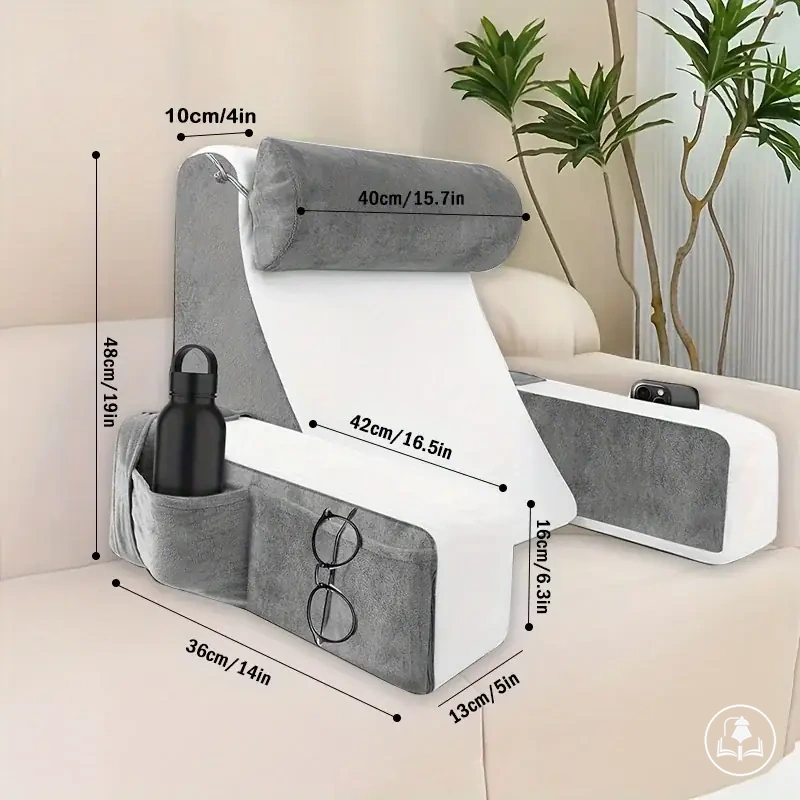


When support matters more than page holding
Body support depends on whether upright reading or reclined reading creates higher back support, neck support, and arm support needs than page holding in a bed reading setup. When posture strain becomes the main constraint, body support becomes the priority condition and page holding plays a secondary role in the reading experience.
In upright reading, back support and neck support are often the main requirements to maintain a stable position, while arm support may also become relevant during longer reading sessions. In reclined reading, cushion support and reader posture alignment change how the body rests on the bed surface, increasing reliance on a reading pillow. In these situations, body support takes priority because comfort depends more on posture stability than on page holding or hands-free positioning.
When hands-free positioning matters more than cushioning
Hands-free positioning depends on whether page angle, page retention, viewing distance, and hand fatigue create stronger constraints than cushioning in a bed reading setup. When control of the book or device becomes harder to maintain, hands-free positioning becomes the priority condition over cushioning because page holding and visibility need more stability than comfort padding alone.
In upright reading or reclined reading, page angle and viewing distance may shift, which can increase hand fatigue and reduce page retention stability. In these situations, stand stability, tilt control, and page holding become more relevant than additional cushioning. The checklist below highlights when hands-free positioning typically becomes the deciding factor in bed reading setups.
Checklist for hands-free positioning priority:
- Page angle: requires stable tilt control for consistent visibility
- Hand fatigue: increases when page holding is unsupported
- Page retention: becomes unstable without proper positioning support
- Viewing distance: needs consistent alignment for comfortable reading
Building a Comfortable Hands-Free Bed Reading Setup
A comfortable hands-free bed reading setup depends on sequencing support, book position, and lighting in a clear order. When these elements are arranged step by step, comfort, reach, glare, and page control become easier to manage without constant readjustment. The setup sequence matters because each adjustment affects the next one.
In most bed reading situations, body support is adjusted first because it shapes overall stability for the reading position. Support influences back support, neck support, and arm support, which affect how steady the rest of the setup feels during use. This foundation reduces unnecessary movement during reading.
After support is set, book angle becomes important because it controls how close or far the reading material feels. Incorrect positioning can increase reach demand and reduce page control, especially during upright or reclined reading. Proper adjustment helps balance reach and page control more consistently.
Lighting placement is adjusted after positioning is stable to reduce glare and improve visibility across the page surface. Light direction should align with the book position to avoid eye strain and improve reading clarity. A structured setup approach is often referenced through reading accessories setup for clearer sequencing guidance.
When all elements are combined correctly, the setup becomes more stable across different reading positions and reduces repeated adjustment needs. However, variations in bed type, posture, and reading habits can still influence comfort outcomes. Product examples should only be considered after setup criteria are clearly established.
The products below are useful examples for comparing available options. Before buying, check that the compatibility criteria, key features, and product details match your needs.
- Support element: adjust body support condition to stabilise posture and reduce strain on back, neck, and arms
- Book position: set book angle condition to control reach and improve page control during reading
- Lighting setup: align light placement condition to reduce glare and improve visibility based on viewing direction
- Stability check: verify stand stability and tilt control condition to maintain consistent hands-free positioning
This chart shows the step-by-step sequence for adjusting body support, book position, and lighting to create a stable and comfortable hands-free reading setup in bed.

Support first, book angle second, lighting third
Support first, book angle second, lighting third is a setup order for a bed reading setup that organises body support, page angle, and light placement in a structured sequence. This sequence helps reduce repeated readjustment and improves overall comfort and visibility during reading.
Without a clear setup order, adjustments in body support, page angle, and lighting can overlap and require repeated changes during use. A structured approach starts with body support, then refines book angle, and finishes with light placement to improve comfort and visibility. The mini-process below shows this setup sequence in a practical order.
- Support first: adjust body support to stabilise posture and improve comfort during reading
- Book angle: adjust page angle to improve reach and page control based on reading position
- Lighting third: adjust light placement to improve visibility and reduce glare across the reading surface
Partner-friendly lighting and low-effort page control
In shared-bed reading, partner-friendly lighting and low-effort page control depend on how the light source, beam direction, and page control method are adjusted within limited shared space. Adjustability and focus matter when reach is restricted and movement needs to stay minimal. In these conditions, shared-bed reading is shaped by beam direction and low-effort page control.
When lighting is too wide or page control requires frequent hand movement, disturbance risk and reading interruptions can increase depending on the setup. Adjusting beam direction and improving focus can reduce unnecessary reach and help maintain reading continuity with lower effort. The checklist below highlights practical adjustments for this setup.
To manage partner-friendly lighting and low-effort page control in shared-bed reading, check the following points:
- Beam direction: align beam direction to limit spill light while maintaining clear visibility for page turning
- Brightness: adjust brightness to support focus without increasing glare in shared-bed reading conditions
- Clip or neck placement: position the light source for stable adjustability and reduced reach during page turning
- Page-control effort: reduce hand movement by improving low-effort page control through better alignment and support
:contentReference[oaicite:0]{index=0}
Common Bed Reading Comfort Problems
Common bed reading comfort problems usually come from poor support, unstable holding, glare, or awkward reach in a bed reading setup. These comfort problems affect stability, visibility, and page handling, and are often linked to how the accessory is positioned or matched to the reading posture.
When poor support or unstable holding occurs, the reading position can feel uneven and require frequent adjustment of body support, book angle, or light placement. Glare and awkward reach can also increase effort during page turning and reduce reading continuity. In most cases, each symptom should be matched against accessory attributes such as support stability, holder grip, beam direction, and reach alignment before changing products. This helps separate setup issues from fit problems.
In shared or single-bed reading scenarios, these comfort problems often appear when posture and accessory design are not aligned with the reading position. Identifying whether the issue relates to support, holding, glare, or reach helps narrow the likely cause and improves adjustment decisions. Further structured guidance on resolving these issues is covered in bed reading fit fixes.
| Symptom | Likely cause | Adjustment or selection signal |
|---|---|---|
| Poor support | Weak body or pillow support alignment | Adjust body support or select more stable support setup |
| Unstable holding | Loose grip or weak holder stability | Improve holder stability or adjust clip positioning |
| Glare | Incorrect beam direction or light placement | Reposition light source and adjust brightness/focus |
| Awkward reach | Incorrect page height or arm distance mismatch | Adjust book angle or reduce reach distance requirement |
Book slipping, pillow collapse, glare, and awkward reach
Book slipping, pillow collapse, glare, and awkward reach in bed reading usually come from different accessory-level causes linked to stability, support structure, light direction, and reach alignment. Each issue points to a different adjustment need, so they should be evaluated as separate comfort problems rather than a single setup fault.
When book slipping or pillow collapse occurs, the issue is often related to holder stability or support firmness. Glare usually connects to beam direction and light placement, while awkward reach is commonly linked to page height or arm distance mismatch. Each symptom should be checked against the related accessory attribute before changing products, since the adjustment or selection signal depends on the specific comfort problem being observed.
Slipping, collapse, glare, and reach issues can appear together in shared or single-bed reading setups, especially when posture and accessory positioning are not aligned. Matching each symptom to its likely cause helps isolate whether the issue is stability, support, visibility, or reach related. The table below outlines the diagnostic mapping for quick reference before applying any bed reading fit fixes.
| Problem | Likely cause | Adjustment or selection signal |
|---|---|---|
| Book slipping | Weak holder stability or low page retention | Adjust grip strength or improve holder stability |
| Pillow collapse | Low firmness or unstable support angle on bed surface | Increase support firmness or reposition base support |
| Glare | Incorrect beam direction or light placement | Adjust beam direction or reposition light source |
| Awkward reach | Mismatch in page height or arm distance | Adjust book angle or reduce reach distance requirement |
:contentReference[oaicite:0]{index=0}